 NEWSLETTER

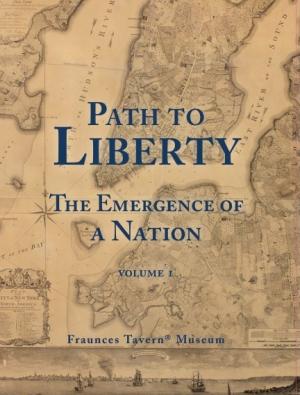 New York, N.Y. - Fraunces Tavern Museum’s permanent collection holds numerous treasures of the American Revolutionary era that bring the stories of those who helped achieve American Independence to life. The Museum showcases a carefully curated selection of those treasures in its Path to Liberty: The Emergence of a Nation special exhibition. To accompany this exhibition, Fraunces Tavern Museum has published Volume I of a catalog to accompany the displays covering the events of April 1775 to March 1777, and a special display of the Museum’s Revolutionary-era orderly books, which is now available for purchase at the Museum’s gift shop and will soon be available for purchase online.
L. Goulet, Collections Manager of Fraunces Tavern Museum states, “This book is a great memento for those individuals who visited our Museum, or for those interested in the topic and cannot make it to the Museum in person.”
Craig Hamilton Weaver, Co-Chairman of the Museum and Art Committee remarks, “This groundbreaking catalog, covering this exhibition, will have six additional volumes over the coming years. Each volume will cover the American Revolution in sequence, as well as a specially curated focus topic, culminating in a final hardcover book spanning the entire 8-year exhibition, unique among museum publications commemorating the nation’s 250th. Readers can follow the Revolution as it unfolds year by year and ultimately have a valued heirloom to treasure for years to come.”
###
Exhibition Website:
frauncestavernmuseum.org/path-
Liberty 250® Website:
frauncestavernmuseum.org/
Sons of the RevolutionSM in the State of New York, Inc., and its Fraunces Tavern® Museum are grateful to those who have supported Path to Liberty: The Emergence of a Nation and Path to Liberty: Orders, Discipline and Daily Life:
Matthew F. Breitenbach and Terry Schwartz Breitenbach
Ronald A. Brown
LTC Lawrence King Casey, Jr. (AUS-Ret.)
Kenneth H. Chase
Colonel Aaron Ogden Chapter, National Society Daughters of the American Revolution
The Colonial Dames of America
James F. Comley
Daughters of the Cincinnati
Deborah and Philip Dwyer
Lynne Hayden-Findlay and Alex Findlay
Peter C. Hein and Anne Farley
William Hale Kirby
Mrs. Stanley DeForest Scott
Peter J.W. Sherwin
Kristofer and Myrna Rosete Swanson
Stephen T. Whelan
Leslie Wickham
###
About Fraunces Tavern:
Fraunces Tavern, located at 54 Pearl Street, was a witness to history throughout the American Revolutionary era. First constructed in 1719, the building that would become Fraunces Tavern was built as an elegant residence by merchant Stephen Delancey. In 1762, Samuel Fraunces purchased the building and transformed it into a tavern that soon became the epicenter of Patriot activity in New York. Fraunces Tavern served as a meeting place for the Sons of Liberty in New York before the War for Independence was declared, and the Continental Army lost possession of the City. During the British Army’s occupation, Fraunces aided Patriots aboard prison ships in New York Harbor and passed on intelligence to the Continental Army. At the end of the War, as the British Army and Loyalists evacuated, the Tavern was the site for trials that were part of a process that led to the emancipation of thousands of Black Loyalists. General George Washington celebrated the final evacuation of the British Army from American shores at Fraunces Tavern on November 25, 1783. On December 4, 1783, nine days after the British evacuation, Washington delivered his emotional farewell to his officers in the Tavern’s Long Room. From 1785 to 1788, Fraunces Tavern became the nation’s first executive governmental building that housed three departments of the Confederation Congress - Foreign Affairs, War, and offices of the Board of Treasury.
About Fraunces Tavern® Museum:
Established in 1907 after a landmark restoration that preserved the integrity of the original Fraunces Tavern building, Fraunces Tavern Museum began its mission to preserve and interpret the history of the American Revolutionary era through public education. Today, the Museum is located in a five-building complex within a Historic District on the National Register of Historic Places that includes the Fraunces Tavern, the oldest building in Manhattan. The Museum attracts tens of thousands of visitors, including school children, annually who can explore exhibitions focusing on America’s War for Independence and the preservation of early American history. The Museum’s 8,000-piece object collection consists of furnishings, communication documents, personal artifacts, and art. While a fraction of the collection is on display at any given time, a significant portion of the collection is available to view on the Museum’s website.