 NEWSLETTER

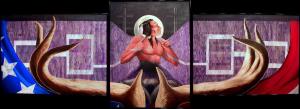 Auburn, NY (May 14, 2026) – The West End Arts Campus, made up of the Schweinfurth Art Center and Cayuga Museum of History & Art, is hosting, Sa:gwáyoˀ Gayogo̱hó:nǫˀ/Cayuga People, We Returned, an important exhibition that focuses on the Gayogo̱hó:nǫˀ experience of forced displacement from and return to their homelands, as seen through their art, song, video, and historical documents.
The Gayogo̱hó:nǫˀ nation is one of six member nations of the Hodinǫhsǫ́:nih/
Haudenosaunee Confederacy, also referred to as the Iroquois or Six Nations Confederacy. The West End Arts Campus is located on the traditional homelands of the Gayogo̱hó:nǫɁ/ Cayuga Nation, which stretched around Gayogo̱hó:nǫˀ/Cayuga and Wahsgǫhǫ:/Owasco lakes, north to Lake Ontario, and south into what is now northern Pennsylvania.
Wahsgǫhǫ:, or Floating Bridge, connected the Gayogo̱hó:nǫˀ to the greater Hodinǫhsǫ́:nih Confederacy. There, floating over marsh land, a bridge provided Gayogo̱hó:nǫˀ ancestors passage to Council meetings at Onǫdagehó:nǫˀ/Onondaga Nation. Today, Wahsgǫhǫ: is known as Auburn, NY, sitting north of Owasco Lake.
The exact date is unknown, but through the leadership of the Peace Maker, the Ganyę́gehó:nǫˀ/Mohawk, Onę́yotga:ˀ/Oneida, Onǫdagehó:nǫˀ/ Onondaga, Gayogo̱hó:nǫˀ/Cayuga, and Onǫdawáˀga:ˀ/Seneca nations united to form the Hodinǫhsǫ́:nih/Haudenosaunee Confederacy. The Confederacy expanded in the 1720s to include the Dahsgaó:węˀ/Tuscarora. This alliance, guided by the Hodinǫhsǫ́:nih Great Law of Peace, ended conflict between the nations and initiated the oldest participatory democracy on Earth.
When European settlers arrived, the Hodinǫhsǫ́:nih negotiated relationships with their new neighbors through treaties known today as the Two Row Wampum and Silver Covenant Chain treaties. These treaties established alliances premised on peace, friendship, and respect. But Euro-American concepts of land as property and land ownership as the prerequisite to vote soon clashed with Hodinǫhsǫ́:nih recognition of land as a relative who they are relationally accountable and reciprocally responsible to.
Hodinǫhsǫ́:nih perspectives and history are pivotal to an accurate telling of the history of the American Revolution and the 250 years that have followed, particularly as this history continues to impact Hodinǫhsǫ́:nih life today. One important example is the Sullivan-Clinton Campaign.
On May 31, 1779, George Washington – then commander in chief of the Continental Army – appointed Major General John Sullivan to attack the Six Nations. “The immediate objects are the total destruction and devastation of their settlements and the capture of as many prisoners of every age and sex as possible,” Washington wrote in his letter to Sullivan. “It will be essential to ruin their crops now in the ground and prevent their planting more.”
Sullivan’s troops destroyed over 40 Hodinǫhsǫ́:nih villages forcing most Gayogo̱hó:nǫˀ and peoples into diaspora during one of the coldest winters on record. In the aftermath of the American Revolution, Hodinǫhsǫ́:nih survivors, including many Gayogo̱hó:nǫˀ, returned home and rebuilt their communities.
Within less than a decade, however, many found themselves living in exile again. Through a series of fraudulent treaties negotiated by New York State, they were defrauded of their lands. These lands were subsequently carved up into “military tracts” used to compensate veterans for their service during the Revolution.
While some Gayogo̱hó:nǫˀ peoples never left their homelands, most have lived on the nation territories of their Hodinǫhsǫ́:nih relatives in Upstate New York, Canada, and Oklahoma. They have struggled to return to their homelands for over two centuries. Since the 1990s, Gayogo̱hó:nǫˀ peoples have been and continue to return and reestablish themselves in their homelands, particularly in the region around Cayuga Lake.
Through the Sa:gwáyoˀ Gayogo̱hó:nǫˀ/Cayuga People, We Returned exhibition, artworks, audio, video, artifacts, and archival documents bridge the circumstances of Gayogo̱hó:nǫˀ displacement, diaspora, and return with a deeper appreciation of Gayogo̱hó:nǫˀ place, society, and politics, as well as historic and contemporary modes of cultural expression. Uniting the Confederacy, Hodinǫhsǫ́:nih artists and makers throughout all Six Nations contribute their voices to this pivotal dialogue on Gayogo̱hó:nǫˀ homecoming, resiliency, and repair.
Through artifacts, historical documents, detailed panels, and contemporary Hodinǫhsǫ́:nih art, the part of the exhibition installed at the Cayuga Museum will address the Gayogo̱hó:nǫˀ history – before, during and after the American Revolution.
Through the contemporary Hodinǫhsǫ́:nih artists, the part of the exhibition installed at the Schweinfurth Art Center will highlight both the ongoing impacts this devasting history of diaspora and dispossession has had on Gayogo̱hó:nǫˀ peoples and their lands, as well as the importance of their resiliency, as a nation, their continued existence in and ongoing return to their traditional homelands.
The opening reception for the Schweinfurth’s exhibition T3%+1le$: The Language of Fiber and People Seen, Places Been at both institutions will be 4 to 6 p.m. May 30. The Opening Celebration of Sa:gwáyoˀ Gayogo̱hó:nǫˀ/Cayuga People, We Returned will be 10:30 a.m. to 4 p.m. Saturday, June 6, on the West End Arts Campus featuring Hodinǫhsǫ́:nih music, dance, arts and crafts, and food. The exhibition will run through Sept. 19, 2026. On Sunday, June 7, both institutions will close to allow the public to visit the Cayuga/SHARE Farm Picnic from 10:30 a.m. to 5 p.m. in Union Springs, which will feature Hodinǫhsǫ́:nih artists, crafts, potluck dinner, and musical entertainment.
Located at Wasco, Sa:gwáyoˀ Gayogo̱hó:nǫˀ/Cayuga People, We Returned is an exhibition curated by Jolene Rickard, Ph.D. (Skarù·ręʔ/Tuscarora) with co-curators Audrey Chan (Brazilian-German and Taiwanese), Noah Mapes (Lac Courte Oreilles Ojibwe descent) and Nikki Dragone, Ph.D., J.D. (Irish/Sicilian/Hungarian/Dakota/Lakota & French Canadian heritage), allied Treaty and Haudenosaunee scholar and Schweinfurth Art Center Program Coordinator.
Special thanks to Hoya:neh Sam George and Stephen Henhawk (Gayogo̱hó:nǫˀ / Cayuga) for their guidance. Hodinǫhsǫ́:nih or Haudenosaunee and Onǫdagehó:nǫˀ or Onondaga are the way they are spelled in the Gayogo̱hó:nǫˀ / Cayuga language and new orthography.
Support for this project is provided by Mary Spurrier, the Nelson B. Delavan Foundation, Fred M. Everett & Ora H. Everett Charitable Trust, Commemorate 250 funding provided by the City of Auburn’s Historic and Cultural Sites Commission and NYS Equal Rights Heritage Center, Cayuga County, 2026 Cayuga Museum Exhibitor Sponsors, and the New York State Council on the Arts.
If you go …
WHAT: Sa:gwáyoˀ Gayogo̱hó:nǫˀ/Cayuga People, We Returned Exhibition
WHERE: West End Arts Campus: Cayuga Museum of History & Art and Schweinfurth Art Center, 203-205 Genesee St., Auburn
WHEN: May 30 to Sept. 19, 2026
HOURS: Cayuga Museum: 10 a.m. to 5 p.m. Wednesdays through Saturdays; Schweinfurth: 10 a.m. to 5 p.m. Wednesdays through Saturdays and 1 to 5 p.m. Sundays
SPECIAL EVENTS:
-- The Opening Celebration of Sa:gwáyoˀ Gayogo̱hó:nǫˀ/Cayuga People, We Returned 10:30 a.m. to 4 p.m. June 6 at West End Arts Campus, 203 & 205 Genesee St, Auburn
-- Cayuga/SHARE Farm Picnic 10:30 a.m. to 5 p.m. at 4061 Truesdale Road, Union Springs
-- Panel discussion with Peter Whiteley (American Museum of Natural History, NYC) Professor Kurt Jordan (Cornell University) and Steve Henhawk (Research Associate with the American Indian and Indigenous Studies Program at Cornell University) at 6 p.m. June 10 at Cayuga Museum’s Carriage House Theater, 203 Genesee St., Auburn
COST: All special events are free and open to the public. Admission to the exhibition on non-special event days is $15 for both institutions.
###
About the Schweinfurth
The Schweinfurth Memorial Art Center is a multi-arts center that opened in 1981 thanks to a bequest from Auburn-born architect Julius Schweinfurth. The art center's programs include more than a dozen exhibitions each year and educational programs for children and adults, which feature local, national, and international artists. For more information, link to schweinfurthartcenter.org.