 NEWSLETTER

 Irish Literature: History & Myth Since 1798 on view September 18, 2026 – January 17, 2027
New York, NY (August 19, 2026)—The New York Historical, New York’s first museum, explores the history of literary Ireland in a new exhibition featuring more than 135 rare books, manuscripts, broad sheets, playbills, drawings, prints, and illustrations. On view September 18, 2026 – January 17, 2027 and drawn from the Leonard L. Milberg Collections of Irish Literature at the Princeton University Library and Leonard L. Milberg’s private collection, Irish Literature: History and Myth Since 1798 reveals how closely the literature, history, and politics of Ireland entwine across the last two centuries.
“Irish literature has long flourished and circulated beyond the confines of its small island, coming to American shores through the Irish diaspora,” said Dr. Louise Mirrer, president and CEO, The New York Historical. “Irish Literature: History & Myth Since 1798 explores how Irish literature provides a model for why art matters in times of crisis, how it functions as an agent of political transformation, and its power to craft alternative historical trajectories. We’re grateful to Leonard Milberg for sharing this collection with our visitors.”
“Some 25 years ago former Princeton President Shirley Tilghman praised my Irish Collection in the Princeton Library Chronicle saying it was the finest in the world outside of Dublin,” said Leonard Milberg. “Now I am thrilled that my Irish Poetry, Prose, and Theatre collections will be shown together so many people can enjoy them.”
The exhibition spans Ireland’s turbulent history, from 1798 to the present with literary examples from uprisings against the British empire, the 19th-century famine, the partition of Northern Ireland and formation of an independent Irish state, ongoing fights for gender equality, and late 20th-century sectarian violence in Northern Ireland.
One of the authors featured in the exhibition is Maria Edgeworth, an important early 19th-century Anglo-Irish novelist. She wrote scathingly about both British and Anglo-Irish upper-class society. Celebrated in America and throughout Europe for her progressive tracts on children’s education, she would influence Jane Austen and Walter Scott with her regional novels. Manuscript letters, her portrait, and the unpublished illustrations of characters from Castle Rackrent, her most famous novel, are on display.
In the 1840s, nationalist poets like Speranza and Thomas Davis used popular literature to call out Britain’s role in the Great Famine. Mid-19th-century novelists like William Carleton and Charles Kickham depicted the horrific effects of the Famine on the lives of individuals to generate sympathy for the Irish poor, while later writers like Liam O’Flaherty were explicitly critical about the political causes underlying the crisis. O’Flaherty’s 1937 novel Famine is on view alongside Colm Tóibín’s work The Irish Famine, published in 1999.
Writing under the pen name Speranza, Jane Elgee—later Lady Jane Wilde—rose to fame as an impassioned nationalist poet publishing in the Nation magazine in the 1840s. Though best remembered as Oscar Wilde’s mother, Lady Wilde wrote essays of scathing feminist and political critiques and lyrical collections of ancient Irish legends. On display is The American Irish, Wilde’s pamphlet from circa 1877, which outlines 700 years of Ireland’s colonial oppression. Wilde believed American values, energies, and respect for human rights created new possibilities for Irish regeneration, viewing Irish America as the place where true revolution against British rule would foment.
In the following decades, Irish artists and writers looked to the country’s mythic past to inspire dreams of a renewed and unified Ireland. The poems, plays, and art inspired by heroes, stories, and landscapes of Celtic legend sought to imagine a culturally united Irish nation. This aesthetic movement, the Irish Literary Revival, aimed to counter the ongoing violence with a new visionary mythology for modern Ireland that could bridge sectarian, class, and political divides amongst the Irish people. Irish Literary Revival writers like Standish O’Grady, Lady Augusta Gregory, and W.B. Yeats often based their work loosely and experimentally on mid-19th-century translations of Irish bardic legends.
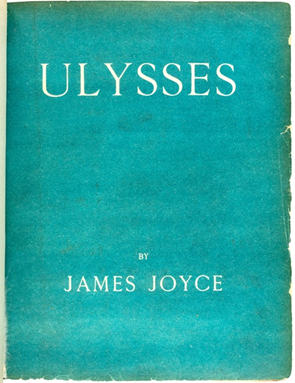
Not all 20th-century Irish writers looked to Irish mythology to heal the rifts of colonial violence. James Joyce criticized the Irish Literary Revival, decrying its romantic longing to create an unbroken modern continuity with “an ancient Ireland [that] is dead.” A first edition of Ulysses, Joyce’s take on the Homeric epic tradition with Leopold Bloom’s mundane journey through Dublin, is on display.
Feminist poet Eavan Boland’s work weaves her experiences of childhood, desire, domestic life, and motherhood into the traumas of Irish history, lamenting the disappearance of women’s personal lives from their public poetic voices. In A Kind of Scar: the Woman Poet in a National Tradition (1989) on view, Boland struggles to develop an Irish poetic self that could be simultaneously national and true to the experiences of womanhood.
The exhibition also explores the evolution of Irish theatre, from the 19th-century plays of Dion Boucicault through the early 20th-century Irish Literary Theatre—later the Abbey Theatre—to contemporary US theatre companies like the Irish Repertory Theatre in New York City. The plays and companies consider Irish and Irish American experiences through drama that speaks to the intersections between identity, history, and belonging. The Easter 1916 uprising interrupted the Abbey Theatre’s Easter week programming, which included a production of W.B. Yeats and Lady Gregory’s 1902 play Cathleen ni Houlihan. Set during the 1798 Rebellion, it features an old woman, Mother Ireland, who demands the blood sacrifice of young Irish men to revive her lost lands. The play’s cancellation due to the Easter Rising cemented its place in the mythology of Ireland’s fight for independence. An original theatrical poster from that week at the Abbey Theatre is on display.
Other highlights include vintage editions of Dracula by Bram Stoker; pen and ink caricatures of notable Irish literary figures like Lady Augusta Gregory and Oscar Wilde; colorful prints by Jack B. Yeats, one of the most important and influential visual artists of modern Ireland; a manuscript draft by Samuel Beckett of a 1961 radio play, Words and Music; a playbill from 1980 of a production of Brian Friel’s Translations; rare works by Seamus Heaney, who won the Nobel Prize in Literature in 1995; and a handwritten copy of a poem by Nuala Ní Dhomhnaill and another translated by Paul Muldoon.
Irish Literature: Myth and History Since 1798 is curated by Renée Fox, PhD; Greg Londe, PhD; and Anne Lessy, assistant curator of history exhibitions and academic engagement at The New York Historical.
Private group tours can also be arranged during the exhibition’s run.
Support
Exhibitions at The New York Historical are made possible by the Saunders Trust for American History, the Evelyn & Seymour Neuman Fund, the New York City Department of Cultural Affairs in partnership with the City Council, and the New York State Council on the Arts with the support of the Office of the Governor and the New York State Legislature. WNET is the media sponsor.
About The New York Historical
New York’s first museum, The New York Historical is a leading cultural institution covering over 400 years of American history. Our offerings span groundbreaking exhibitions; peerless collections of art, documents, and artifacts; acclaimed educational programs for teachers and students nationwide; and thought-provoking conversations among leading scholars, journalists, and thinkers about the past, present, and future of the American experiment. The New York Historical is a museum of museums and a collection of collections. We are home to the Patricia D. Klingenstein Library, the Center for Women’s History, the DiMenna Children’s History Museum, and the future American LGBTQ+ Museum. We elevate the perspectives and scholarship that define the United States’ democratic heritage and challenge us all to shape our ongoing history for the better. Connect with us at nyhistory.org or at @nyhistory on Facebook, Twitter, Instagram, TikTok, YouTube, and Tumblr.